Full-stack privacy for Ethereum. We protect writes with zero-knowledge proofs, reads with private information retrieval, and the network with mixnet routing. No single point leaks who you are or what you want.
Confidential transactions
Orders are committed as encrypted UTXOs using ZK-SNARKs. The chain verifies validity. It never sees the asset, direction, or size.
Private information retrieval
Every read uses PIR. The server answers your query without learning what you asked. No RPC provider sees your access patterns.
Nox mixnet routing
Every API request travels as Sphinx packets through three Nox hops with random delays, so the services you call see only an exit node's address.
Compliance by design
Every transaction is private by default. Disclosure is designed as a threshold-committee decision, with the on-chain attestation log already deployed on testnet. Testnet runs on a dedicated testnet compliance key held by Hisoka, with the committee key ceremony as a mainnet milestone. Privacy for all. Accountability when legally required.
Sphinx mixnet for HTTPS, TLS tunnels, JSON-RPC and Ethereum transactions, with random per-hop delays, node cover traffic and anonymous replies. Live on testnet.
Private information retrieval for Ethereum. Query balances, proofs, and contract state without revealing your access patterns to any RPC provider.
Fully confidential dark pool protocol for Ethereum. A ZK-UTXO shielded pool live on Arbitrum Sepolia testnet, routed through Nox so no layer leaks intent or identity. External audit planned ahead of mainnet.
Decentralized solver network purpose-built for privacy protocols, where solvers compete on execution quality with zero visibility into the underlying order or the trader behind it. The Kage swap verifier is live on testnet; the orderbook and solver are in build.
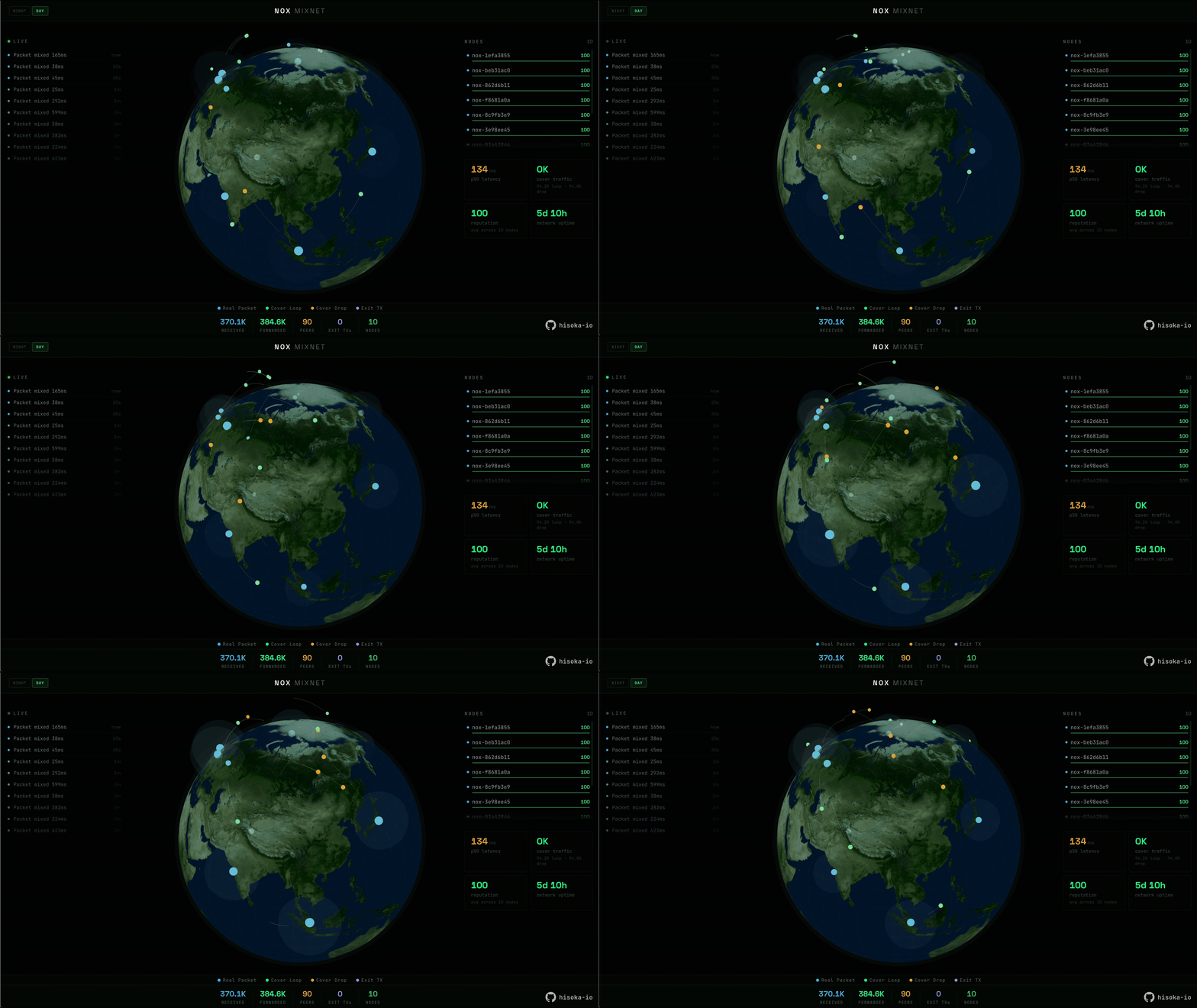
The network is running. Live since April 2026, 10 nodes are mixing Sphinx packets in real time, and operator onboarding is open. Browser wallets reach it through the Nox worker for the anon-rpc standard, with end-to-end TLS to the RPC provider: try the demo. Watch it live or start running your own node.